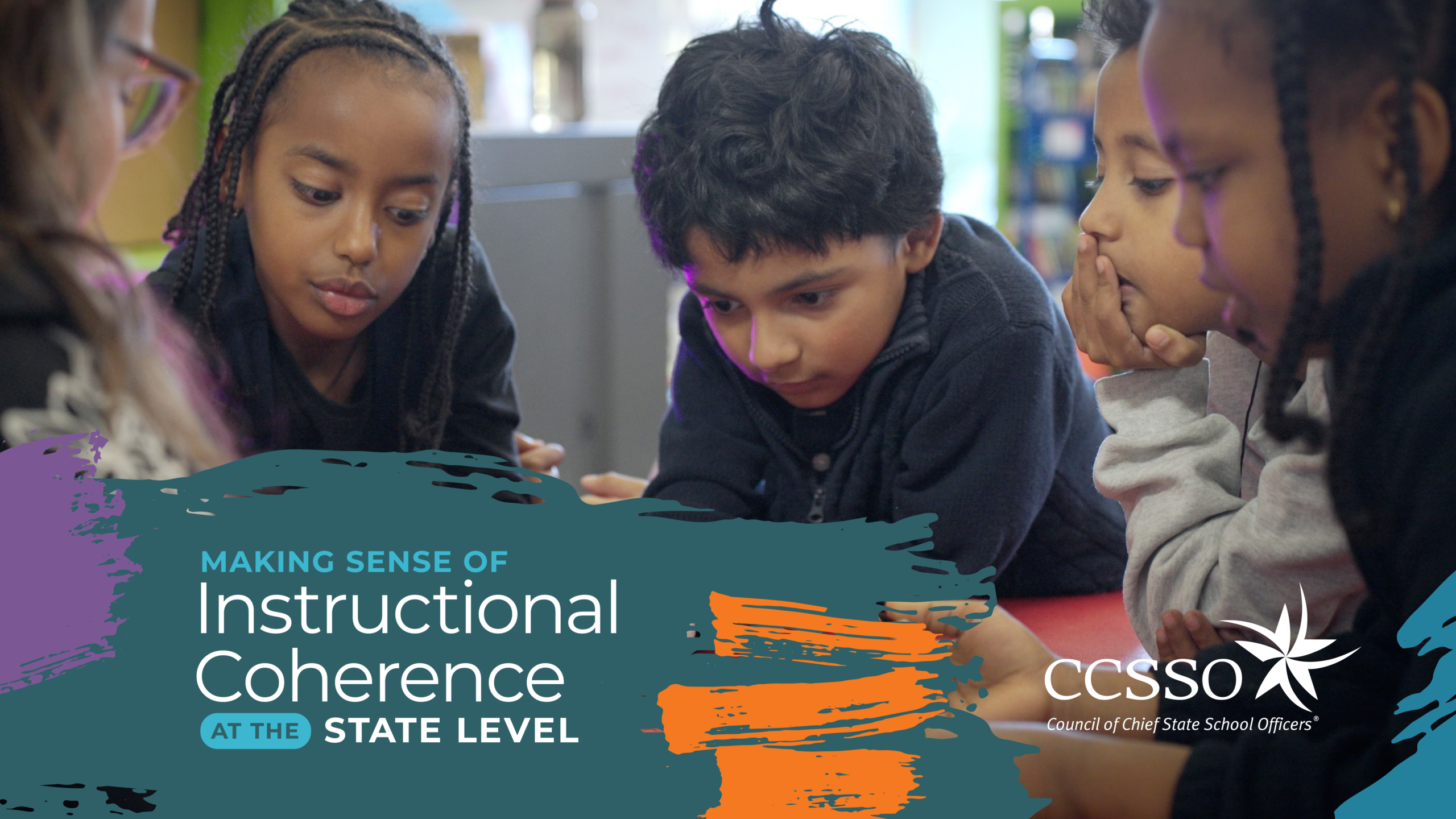
State education leaders are committed to investing in young learners. High-quality early education programs can improve outcomes, narrow achievement gaps and convey long-term benefits for children in school and life. CCSSO’s support to states is focused on creating conditions to facilitate developmentally appropriate, high-quality early learning experiences for young children.
In 2017, CCSSO launched the Early Learning Networked Improvement Community (NIC) to support the implementation of evidence-based practices in early math and literacy in PreK–Grade 3 by providing professional learning opportunities with the support of national experts to improve outcomes for all students. Support through the network also includes strengthening the alignment of state education agencies, local districts and schools in using improvement science to establish a culture of improvement at the state and district levels.
The NIC previously provided targeted support to Maryland, Nebraska, New Jersey and Vermont. Currently, the network supports New Jersey and Vermont and is comprised of teachers, coaches, building administrators, district lead staff and administrators from the state education agency. Members of the network and cohorts of teachers in the two states participate in a year-long professional learning opportunity using a method known as improvement science, a problem-solving approach centered on continuous inquiry and learning. Learn more in this video and explore highlights from state teams below.
-The Maryland team joined the Early Learning NIC in March 2017 and focused on foundational literacy skills in PreK and kindergarten. From 2020-22, two districts, Washington and Wicomico, developed goals to clearly communicate the expectations for teaching literacy, in a concise and consistent manner, aligned to the science of reading in order to accelerate literacy achievement. The state developed high-impact literacy practices which offer alternatives to standard classroom practices that are evidence-based and established a professional learning community to support educators.
-The Nebraska team included two districts that exclusively focused on early math to increase and strengthen practitioner use of high-quality instruction evidenced by the Classroom Observation of Early Mathematics Environment and Teaching (COEMET) instrument evaluation tool. The district participated in several six-hour-long online sessions followed by consultations with school-level collaborative learning teams.
-The New Jersey team has been with the Early Learning NIC since 2017. Representatives from the New Jersey Department of Education, the Long Branch School District and all schools within the district have been implementing professional learning actions to improve teaching evidence-based early math, learn more here. In 2022, the Middlesex School District adopted the approach in early literacy and math for teachers in PreK to 3rd Grade.
-The Vermont team established teacher cohorts within three districts for early literacy and math with the goal of improving instruction in foundational skills and formative assessment practices through embedded professional learning, coaching, and examination of student work/learning. The state education agency is focused on change management and capacity building to spread and scale evidence-based practices across the state. Learn more here.
CCSSO collaborates with a group of partners on this project who share a similar goal: improvement in teaching and learning rests on the competencies and abilities of teachers.
You can learn more about Phase II of the Early Learning Networked Improvement Community in this evaluation report. Learn more about CCSSO’s work to support early learning here.
This project was funded by the Education Program of the Heising-Simons Foundation.