Science of Reading Legislation and Implementation State Scan

Access Scan
Overview

State education leaders are committed to improving literacy outcomes for all students in their states. Collectively, they are making a concerted effort to ensure reading instruction is grounded in the science of reading and that educators have the support and materials they need to set students on a path to success.

The Science of Reading (SoR) Legislation and Implementation State Scan is designed to support states that already are implementing SoR legislation and related policy or are interested in taking action on SoR policy in the future. CCSSO is committed to supporting states in learning from one another and much of this starts with having a clear picture of what each state is doing. Other organizations have done strong work to describe and analyze states’ SoR laws. This resource builds on that foundation by capturing state efforts to develop and implement policy aligned with four evidence-based practices that will set both students and educators on a path to reading success, including:

  1. State Obligation to Provide SoR-Based instructional Materials: Not all early literacy materials are consistent with the SoR and not all early literacy materials are comprehensive. Getting core instruction right is crucial, and teachers deserve to have high-quality instructional materials (HQIM) anchoring their classroom practice. States are supporting districts by creating state mandated or recommend materials lists, providing rubrics or guidance on selecting HQIM, and creating grant programs to incentivize selection of them.
  2. State Obligation to Train Educators in SoR: The move to SoR requires addressing several aspects of professional learning for educators. Research clarifies that educators need two types of training about SoR including the research on the SoR and curriculum-based professional learning to support teachers in translating that research into practice. States are providing statewide trainings on the research of SoR to educators, funding literacy coaches to support with classroom implementation, and a smaller set of states are requiring districts to submit professional learning plans in line with their state guidelines.
  3. Obligation of Educator Preparation Programs (EPPs) to Train Aspiring Educators in SoR: Aspiring educators also need training in SoR. With this training, educators have a foundation to successfully implement evidence-based instruction in their classrooms that is aligned to SoR on Day 1. States have found early successes enhancing teacher competency standards, updating Educator Preparation Program (EPP) coursework, and updating licensure requirements.
  4. State Obligation to Communicate with Partners: Experience repeatedly teaches us that strategic communication is critical to the success of any new policy. Even if a law requires a state to take an action, that action will be better received and implemented with more intentionality and commitment with broad partner awareness and buy-in of the effort. Many states’ legislation requires some level of communication and engagement with families.


How to Use This Tool

This resource is intended to be used by state leaders to share information on SoR legislation and how states are approaching implementation of that legislation. The tool allows for states to learn from one another.

The functionality of this tool allows a user to search by state, by the four categories of promising practices within the field and by trends and key words within the content presented in the table using the preset dropdowns in the dashboard. Where available, implementation timeframes and links to relevant resources and guidance are provided.
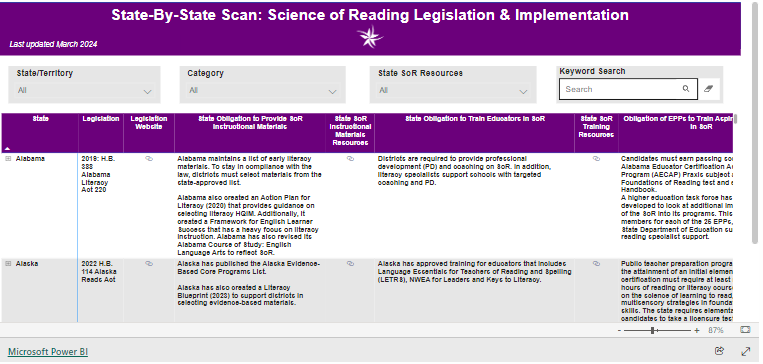
A more detailed explanation of the research underpinning each of these four promising practices, as well as how states are approaching implementation, is included in the overview document here.

You can learn more about CCSSO’s literacy efforts here.

More Related Resources


Tags: , ,